
Thetford perseveres with rollout of EV chargers, avoids federal funding uncertainty
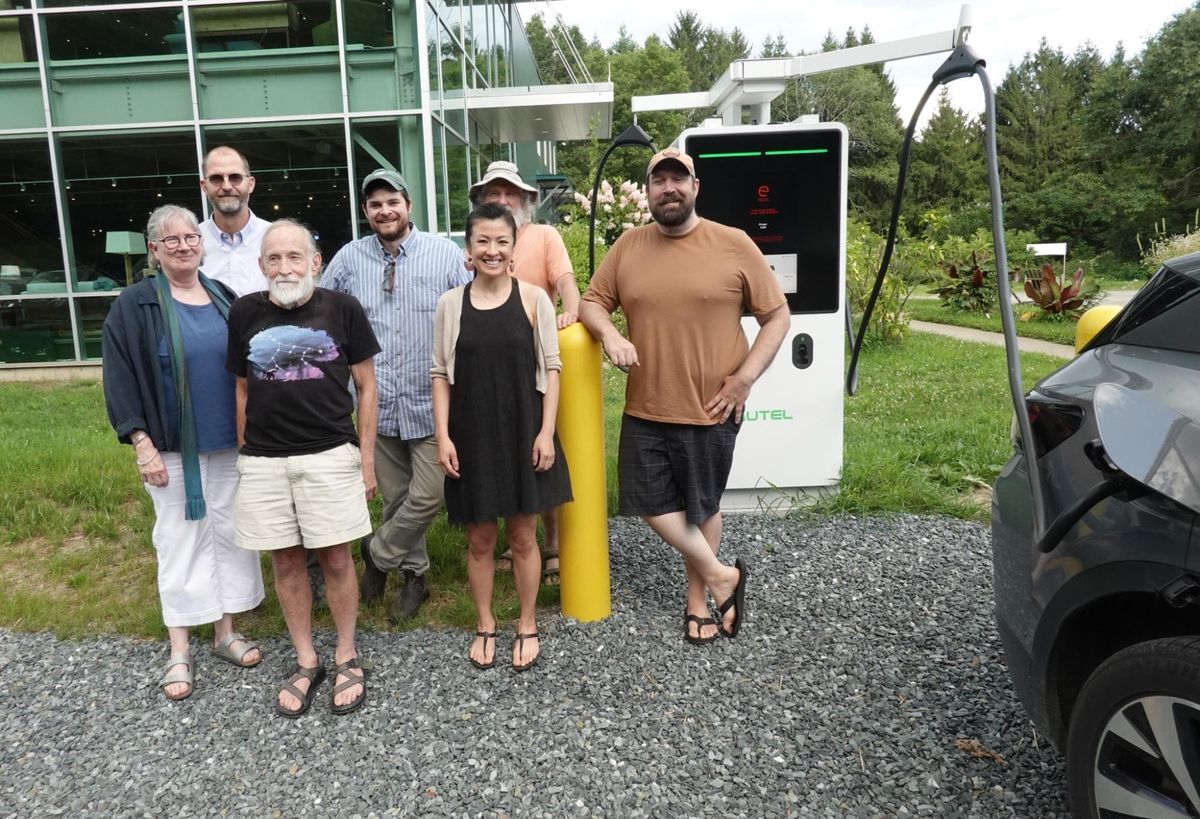
On Thursday, August 13, the Thetford Energy Committee, accompanied by the Regional Planning Commission's Shared Energy Coordinator Harry Falconer, celebrated the installation, at Pompanoosuc Mills in East Thetford, of a Level 3 fast charger for electric vehicles (EVs). There were smiles all around as the group tried out the new equipment using Harry's car as the test subject.
This was the culmination of a two-year process — more than two years if you count the EV Charger Siting Study commissioned by the Energy Committee about four years ago. That study recommended placing EV chargers at Thetford Elementary School and in East Thetford.
At that time things looked rosy for EVs in Vermont. The state had been building public EV charging stations since 2014, investing over $3.5 million. As of July 2025, Vermont had over 497 publicly accessible charging stations (with 1,266 charging ports), maintaining its lead as the state with the highest number of EV chargers per capita in the US. These chargers help to power the 19,374 plug-in passenger vehicles and light-duty trucks in the state.
The increasing use of EVs is particularly beneficial in a state like Vermont. It helps to offset the greater amount of carbon pollution emitted by rural drivers compared to their city counterparts. Rural living is not good for the climate. Sparse settlement patterns result in greater physical separation between homes, jobs, schools, and commercial centers. Rural people drive greater distances and rely more on larger vehicles like trucks and SUVs. Public transportation is not an option for many.
In 2021 President Biden opened the gates to increasing EV chargers with the National Electric Vehicle Infrastructure program (NEVI) through which almost $21 million in funding (spread across 2022-2026) became available to Vermont for EV chargers. To make the best use of this windfall, the Vermont Agency of Transportation (AOT) worked to build upon the state’s early success by developing a ten-year, statewide strategic Electric Vehicle Supply Equipment (EVSE) deployment plan. This electrification of transportation also fulfills a top priority of the VT legislature's Climate Action Plan. By December 2024, the AOT had solicited proposals and awarded 11 EV public charging station projects that were compliant with NEVI funding guidelines. One of these, in Bradford, was built before the Trump administration suspended the program in February 2025.
The NEVI program had aimed to place EV chargers within three miles of interstate exits and every 25 miles along state highways. However, it happened that the EV charger planned by the Thetford Energy Committee for East Thetford didn't fall under this program. Harry Falconer tapped into another source, an initiative called Charge Vermont that is funded by the state of Vermont with revenues from additional registration fees for electric vehicles. The program is administered by Green Mountain Power.
The funding was secured in 2024, and it was up to Thetford to manage the site location of the charger. This was more easily said than done. The Energy Committee expended much time and effort into approaching East Thetford businesses, one at a time, only to have all of them withdraw or say "No" for one reason or another. It was beginning to look bleak, because one condition of the funding was that the EV charger must be located within a five-minute walk from a "mixed use area," meaning a commercial or municipal hub. As time was running out (the grant would expire if not spent), the Energy Committee approached Dwight Sargent, the founder and CEO of Pompanoosuc Mills, headquartered in East Thetford. It so happened that Dwight had looked into installing a fast EV charger on his own dime, but found the cost prohibitive. He was delighted to be able to host one.
Being the host incurs certain obligations for five years, like keeping the facility accessible and in good order. However the host is not the same as the owner/operator of an EV charger. The host grants the operator legal access to a specified area of their property, sometimes in exchange for revenue. In this case, the owner/operator is Norwich EV LLC, a subsidiary of the company Norwich Technologies (owner of Norwich Solar). And not any old company can become an owner/operator of a public EV charging facility. As part of their EVSE Deployment Plan, the state selected eight providers who were eligible to design, construct, own, operate and maintain such facilities, one of them being Norwich Technologies.
Putting together the whole funding package required Harry to do a little juggling. The total cost of the project was $183,000. Of that, the grant from Charge Vermont covered a generous $145,000. A rebate of $10,000 came from Green Mountain Power, the EV program administrator, and Norwich EV made up the rest. The major expense of extending the three-phase power line required for a Fast charger was avoided because Pompanoosuc Mills is already equipped. Three-phase power is needed by their manufacturing equipment.
This is not the only achievement of the Energy Committee-Harry Falconer team. In fall of 2025 they presided over the installation of a Level 2 charger at Thetford Elementary School. This was also funded by Charge Vermont under a different program than that for Level 3 Fast chargers, one focused on EV chargers at workplaces. Because this charger is for TES employees, it is not available to the public during school hours, nor is it listed on public EV charger apps. However, residents may sign up online to use it between the hours of 4:00 and 11:59 p.m. Overnight parking and charging are not allowed.
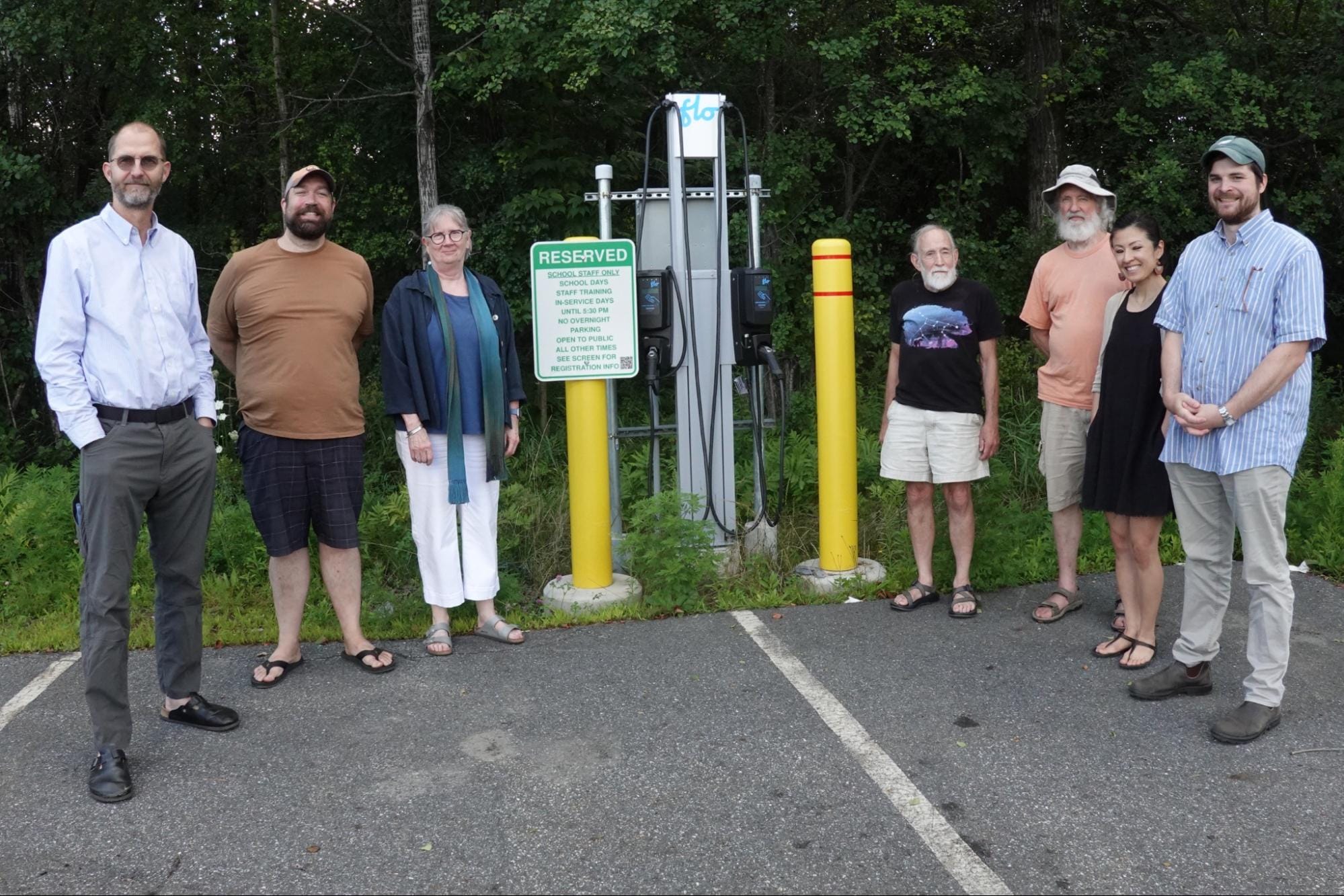
One complication of installing this charger was the request to locate it well away from the school building. To do that, the electrical supply cable was buried, at some expense, across the entire length of the parking area.
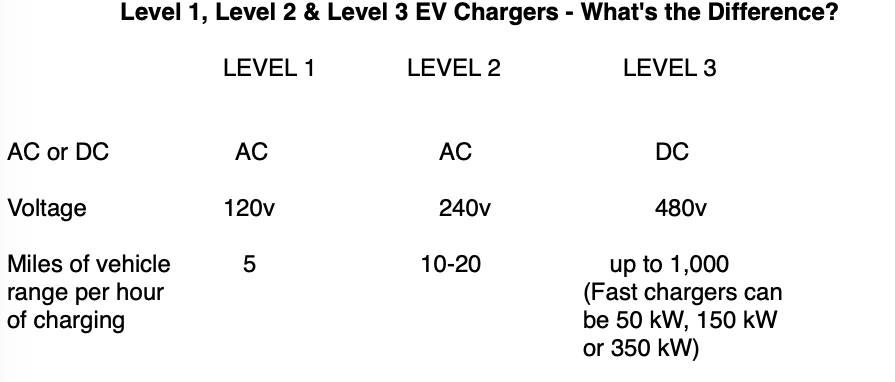
It would appear that a good place to site EV chargers would be at the Park ‘n’ Ride beside the I-91 entry ramp. Indeed there are, or were, three-pin 120v outlets there that would accommodate Level 1 — the slowest form of charging — adding 5 miles of range to an EV's battery per hour of charging. While this seems laughable, there is a reason for it. The Park 'n' Ride is within the right-of-way of the federally funded highway system. The law prohibits commercial activity in this area, which includes selling electricity through Level 2 and Level 3 chargers. Exceptions to this law are the vending machines and sales of maps offered by the State at rest areas. Thus the Level 1 charging service is, or was, free. (Most of the outlets have been removed or deactivated because of abuses.) Only grandfathered toll highways built solely with state funds and later absorbed into the Federal Interstate System are allowed to keep their commercial service plazas.
The electrification of transportation on a large scale may get a short-term reprieve. In August of 2025, US Transportation Secretary Duffy reviewed the "failed" implementation of the NEVI program and allowed states to submit, within 30 days, EV Infrastructure Deployment Plans under new "interim" guidelines that rescinded language that would have ensured "equitable distribution of services … towards disadvantaged communities ... and opportunities for minority and women-owned small businesses."
Photo credit: Li Shen