
It Took Four Years but Safety Wins Out Over Wakesports on Lake Fairlee
Years have elapsed since 2022, when the citizens' group Responsible Wakes for Vermont Lakes petitioned the Vermont Agency of Natural Resources (ANR) to curtail the use of wake boats on Vermont’s inland lakes and ponds. These high-powered motorboats, engineered with water-filled ballast tanks to generate massive surf waves, have grown in popularity nationwide and in Vermont. However, traditional lake users argue that these powerful wakes endanger swimmers, kayakers, paddleboarders, and anglers. Environmental advocates and scientific studies also emphasize that the heavy waves disrupt shallow-water ecology, threaten nesting loons, stir up algae-promoting sediment, and risk spreading aquatic invasive species through un-decontaminated ballast tanks.
In response to the original 2022 petition, the ANR implemented the nation's first major statewide wake sports rule in April 2024. That framework restricted wake sports to designated "wakesport zones"—requiring a minimum of 50 contiguous acres of water that was at least 20 feet deep and 500 feet from shore. The state justified this 50-acre baseline using specific geomorphological calculations, asserting it allowed for a minimum wakeboarding run of 3,000 feet (equivalent to a 3-minute run at 11.5 mph) and gave boats enough room to remain 200 feet from other vessels or swimmers (the standard separation distance applied to all vessels moving over 5 mph). The framework of this initial rule allowed wake boats to operate on 30 of Vermont's smaller lakes.
However, many lake users felt this rule was inadequate to protect safety. Opposing petitioners had maintained that a 1,000-foot shoreline distance was actually required before a wakeboat’s massive wave energy dissolved to match that of a traditional waterskiing boat at 200 feet. They also maintained that swimmers and small non-motorized craft would be endangered if a wakeboat were operating within 200 ft of them. In all, over 100 written comments were received, the greater majority calling for more restrictions, if not an outright prohibition on wake boats.
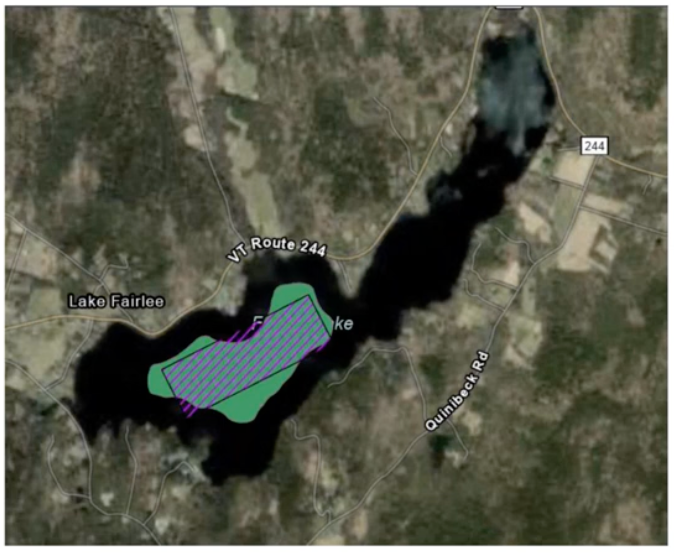
Public pushback from local residents noted that, under this rule, a single boat could effectively monopolize significant areas of a lake’s public waters. This was especially true on Lake Fairlee, where the WSZ was surrounded by 4 of the lake’s 5 summer camps. The following comment encapsulates concerns typical of the public comments submitted to the DEC: "As a day user of Sunset Lake in Benson, I witness daily the families with small children playing along the shore, kayakers & paddle boarders and sometimes several small sail boats all using the lake in harmony. How is it fair to every other user of Sunset Lake that one wake boat can occupy nearly 40% of the total lake surface - according to your published map? For one use, driving the rest of us to the periphery is unfair. It’s time for VT DEC to be a leader and not a follower in this rule making effort. Sunset Lake is a jewel along with several other small lakes in Vermont that deserve better treatment."
DEC communicated at the time that it did not consider safety issues when developing the 2024 rule and anticipated receiving petitions from individual lakes for stronger protections. Determined to find a safer solution, the Lake Fairlee Association (LFA), the selectboards of Thetford, Fairlee, and West Fairlee, and all five Lake Fairlee summer camps filed a "single-lake petition" in April 2024. They appealed to the Department of Environmental Conservation (DEC) to enact a localized wakesports prohibition, arguing that the statewide rule ignored safety and economic realities. Lake Fairlee is uniquely dense, hosting 1800 annual campers at summer camps whose collective annual revenue exceeds $6 million and yields over $300,000 in local property taxes to the surrounding towns. Compromised safety threatens the economic health of these camps and the economic value these businesses contribute to the area. This was one of several reasons the petition called for a wakesports prohibition on the lake.
Lake Fairlee was not alone in its concerns; a total of nine individual lake petitions were filed after the initial 2024 rule was implemented. In the summer of 2025, the DEC denied all nine individual petitions. Rather than managing public waters via a piecemeal, complicated patchwork of varying local rules in the rule appendices, the DEC determined it would be more effective to address the issues by strengthening the 2024 statewide Use of Public Waters Rule.
The ANR proceeded with a thoughtful, lengthy, and transparent rulemaking process, as required by the state’s rulemaking statute. This included extensive stakeholder meetings and a public comment period where over 1,500 written submissions were carefully weighed by state officials. The final amended rule was filed with the Legislative Committee on Administrative Rules (LCAR) in April 2026, and on May 21, 2026, the LCAR officially voted to adopt the new, stronger amendments.
The updated rule—set to go into effect on June 11, 2026—reinforces Vermont as an environmental leader, establishing the most protective statewide wakesports regulations in the United States:
- Expanded Wakesport Zones: Wake sports zones must now be a minimum of 100 contiguous acres (doubled from 50 acres) that are at least 20 feet deep, 500 feet from shore, and feature a continuous straight-line length of at least 3,000 feet.
- Increased Safety Offsets: While creating enhanced waves, wake boats must now maintain a 500-foot safety buffer from all other watercraft, swimmers, and docks (up from 200 feet).
- Wildlife Protections: The seasonal buffer around active, signed loon nesting sites has been increased from 300 feet to 500 feet.
- Universal Ballast Decontamination: Abandoning the previous "home lake" concept, the state now requires all ballasted watercraft to undergo a low-pressure hot water (120°F) internal flush and high-pressure hot water (140°F) external rinse before traveling between different bodies of water. Enforcement of these invasive species transport laws will transition to a self-certification model, where boat operators must certify that their vessels were decontaminated according to Agency rules.
Regulations strictly govern the activity of wakesports and the generation of enhanced wakes, not wake boats. Wake boats may still ply the waters of Vermont lakes, but only in a non-enhanced wake mode for traditional activities such as waterskiing, cruising, or fishing. Under the new rule, activities such as wakeboarding are still permitted behind a wake boat or any other boat, as long as enhanced wakes are not created.
Lake Fairlee’s WSZ only contains 90.4 acres, falling short of the new 100-acre threshold. As a result, Lake Fairlee is one of 12 small lakes—including Holland Pond, Joe’s Pond, Lake Hortonia, Lake Iroquois, Lake Parker, Miles Pond, Molly’s Falls Reservoir, Peacham Pond, Shadow Lake in Glover, Sunset Lake, and the Waterbury Reservoir—that are now completely off-limits to wake sports. Out of 30 inland lakes previously open to wakesports, 18 remain wakesport eligible. While Lake Fairlee's traditional lake users celebrate a major victory for safety and improved environmental protection, wakesport enthusiasts will have to redirect their vessels to larger eligible waters.